Pages

Saturday, July 28, 2012

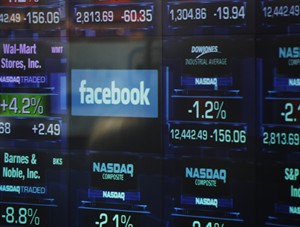
Facebook Shares Down 37% since IPO

Facebook Shares Down 37% since IPO, facebook, mark zuckerberg


Investors fled the stock in droves because they are unhappy with Facebook’s first financial report as a public company on Thursday, even as Mark Zuckerberg brag about its growth prospects to industry analysts. Facebook’s stock lost 18% of its value on Thursday. The first blow came during regular trading largely because of the poor results posted by Zynga, the social game company that uses Facebook as a platform.

Facebook stock continued to plummet in after hours trading after Facebook announced its own numbers, dipping below $24, a record low. Since going public two months ago at $38 a share, Facebook shares have lost 37% of their value.

The company said its revenue for the quarter climbed to $1.18 billion, from $895 million; most of it came from advertising.

The company reported a net loss of $157 million, or 8 cents a share, compared with net income of $240 million, or 11 cents a share for the same quarter last year. Much of that was because of stock compensation, and on an adjusted basis, the company posted a profit of 12 cents a share, or $295 million, meeting analysts’ expectations.

Zuckerberg has rarely spoken publicly about the company he built in his dorm room eight years ago. But nothing he and his lieutenants said on Thursday about their plans to make money by advertising to Facebook users seemed to reassure investors.

Monday, July 23, 2012

Spanish government bonds dive on bailout fears


* Risk of Spanish bailout grows; bonds in free fall
* Greek funding worries add to peripheral pressure
* Bund yields set to mark new lows on safe-haven flows

Spanish government bonds sank on Monday, pushing yields sharply higher, on fears the government will lose access to debt markets and need a full bailout as its regions began lining up for financial help.

Worry over Greece resurfaced with international lenders scheduled to gather in Athens to discuss the terms of further rescue payments, after its prime minister said the country was mired in a "Great Depression"..

As risk aversion dominated financial markets, five- and 10-year German government bond yields hit new lows and U.S. T-note yields hit their lowest since the early 1800s.

The Spanish region of Murcia moved closer to following Valencia in seeking financial aid from the government, which set up an 18 billion euro fund earlier this year to help the regions refinance their debt. Media reported half a dozen others were ready to do likewise..

"Given the market reaction on the back of the news that more and more regions are looking to tap into the liquidity fund..., it will be very difficult for Spain to circumvent further support for itself," said Norbert Aul, a rate strategist at RBC Capital Markets.

Full Story here  


Wednesday, July 4, 2012

Asian Shares Higher on Stimulus Hopes; Australia Hits 7-Week High

*Nikkei gains 0.4%, Hang Seng Index down 0.1%, S&P ASX 200 up 1.1%

*Asian stock rise on stimulus hopes

*Philippine peso hits a four-year high against the dollar


News on European and U.S. central banks will issue more stimulus measures to help economic growth benefited Asian shares. Asian shares were mostly higher on Wednesday, pushing Australian stocks to a seven-week high and the Philippine peso reaching its strongest in four years.

Investors are looking towards a European Central Bank rate decision meeting on Thursday, as well as U.S. employment data on Friday, which is expected to encourage the Federal Reserve to implement more policy easing. Sentiment was also helped by news that orders for U.S. factory goods were up in May, reversing two months of declines.

The price of oil mainained its 4.7% overnight gain, although it dropped to $86.63 a barrel later in the day. Higher crude oil prices gave a boost to oil companies: in Australia Aurora Oil and Gas climbed 2.8% and in Japan Inpex Corp gained 2.9%.

Australia's S&P ASX 200 was up 1.1% to 4172.20 as resource companies led broad-based gains after commodity prices surged and offshore equities keep rising on hopes of policy stimulus. BHP Billiton gained 2.1%, Rio Tinto was up 2.7% and Fortescue Metals Group was 3.7% higher.

Gold eased to $1613.20 an ounce.

Japan's Nikkei and South Korea's Kospi were both up 0.4%, at 9104.17 and 1874.45 respectively.

In China, the Shanghai Composite was less than 0.1% lower at 2227.31, while the Hang Seng Index was also 0.1% lower at 19709.75.

The euro lost some of its 0.3% overnight gains $1.2582; Dollar was at 79.75 Japanese yen.

Regional risk currencies gained on the risk-on sentiment. The greenback went down to 1,132.70 against the won early in the session, a two month low, owing to dollar selling by exporters. Late in the afternoon the won was at 1136.40, compared with 1,138.30 on late Tuesday.

The currency star performer was in the Philippines where the dollar hit a four-year low against the Philippine peso at 41.65 to the dollar. The strengthening currency forced the central bank to intervene with traders saying that it bought around $100 million to support the dollar and weaken the peso.

Monday, June 4, 2012

Global shares head lower as world slowdown fears grow


(Reuters) - European shares joined a global sell-off in riskier assets on Monday after disappointing May economic data from the United States and China overwhelmed any positive impact from hopes the world's central banks would ease policy further.

The euro slid 0.3 percent to $1.2400, moving closer to the $1.2288 it hit on Friday, its lowest level since July 2010, while Brent crude oil fell below $97 a barrel to a 16-month low.

Safe haven U.S. and German government bond yields held near Friday's record lows., "Investors are just fleeing risk assets," said ATI Asset Management chief investment officer Simon Burge.

The latest sell-off followed disappointing U.S. jobs growth figures on Friday and weak Chinese manufacturing data, which stoked fears that the problems in the euro zone are causing a worldwide slowdown in business activity.

Those fears caused sharp falls across Asian markets on Monday, dragging Tokyo's Topix index (.TOPX) to a 28-year low, and followed a fall of more than 2 percent in U.S. stocks on Friday. The MSCI world equity index <.MIWD00000PUS> was down 0.5 percent at 290.58 points.

UK markets were closed for a holiday on Monday, though the FTSE Eurofirst (.FTEU3) index of top European shares opened down 0.7 percent at 2054.97 points after hitting a six-month low on Friday.

Tuesday, May 22, 2012

Facebook shares sink again

Oh crap! Facebook shares sank further Tuesday amid new accusations that key underwriters had cut their forecasts for the company just days before Friday's initial public offering.

Facebook shares lost another 8.6 percent Tuesday, closing at $31.12, leaving them 18.1 percent below the IPO price.

The shares continued to fall in after-hours trade, falling to as low as $30.72, as analysts and investors concluded that the $16 billion, 421 million shares IPO was just too big for the real demand and that major early institutional investors had not intended to hold on to them.

On Tuesday reports surfaced that Morgan Stanley and two other key underwriters, JP Morgan and Goldman Sachs, had cut the forecasts they provided to their customers days before the issue.

Saturday, May 19, 2012

Facebook debut as a public company closes nearly flat


Facebook's IPO, turns out to be a bust. It was expected to be big but that didn't happen. One of the most anticipated IPOs in Wall Street history ended on a flat note Friday, with Facebook's stock closing at $38.23, up 23 cents from Thursday night's pricing. For all the hype and expectations, many are seeking a big first day pop in Facebook's share price, the increase of six-tenths of one per cent was a big letdown.


Friday, March 23, 2012

World stocks mixed ahead of US housing data

BANGKOK (AP) -- Asian markets fell Friday amid mounting jitters over China's manufacturing slowdown. European stocks advanced and Wall Street futures rose as traders awaited the release of U.S. housing data.

Benchmark oil hovered above $105 per barrel after a big fall the day before. The dollar weakened against the euro but rose against the yen.

Britain's FTSE 100 rose 0.5 percent to 5,873.87. Germany's DAX gained 0.6 percent to 7,022.42 and France's CAC-40 added 0.4 percent to 3,486.70.

In Asia, stocks were jolted for a second day in a row by an index, released Thursday, that showed renewed weakness in China's manufacturing. The gauge compiled by HSBC fell to 48.1 in March from 49.6 in February. Figures below 50 indicate that manufacturing is shrinking.

That data comes on top of trade figures showing both Chinese and global demand falling. Weak European economic indicators added to worries about a slowdown.

"The market is disappointed that China's manufacturing sector is shrinking, so we are seeing the start of a major correction," said Francis Lun, managing director of Lyncean Holdings in Hong Kong.
The lack of bold reaction from China's government is causing investor unease, analysts said. The government has indicated it favors a pro-growth policy but so far has not aggressively reduced reserve requirements for banks on a national scale or lowered interest rates.
"China hasn't done anything to inject confidence in the market," said Jackson Wong, vice president at Tanrich Securities in Hong Kong. "That is dragging down the whole market in Hong Kong and other areas. So now we wait to see if China will roll out some bold moves."
Japan's Nikkei 225 index dropped 1.1 percent to close at 10,011.47 as the country's formidable export sector faded amid fears of slowing overseas demand. Yamaha Motor Co. shed 3.1 percent and Sharp Corp. slid 3.3 percent.

A rare gainer was Japanese food processor Yukiguni Maitake Co., which rose 0.3 percent a day after announcing a study showed that maitake mushrooms might help fight obesity, Kyodo News reported.

Elsewhere, Hong Kong's Hang Seng lost 1.1 percent to 20,668.80 while South Korea's Kospi edged up marginally to 2,026.83.
Australia's S&P/ASX 200 fell nearly 0.1 percent to 4,270.40 as the country's mining and resource shares took a pounding over worries of reduced demand from China, the world's biggest consumer of raw materials. BHP Billiton, the world's largest mining company, lost 1.2 percent in Sydney.
Wall Street appeared headed for a higher opening, with Dow Jones industrial futures up 0.2 percent to 13,029 and S&P 500 futures adding 0.4 percent to 1,393.90.

Later Friday, the U.S. government will release a report on the number of people who bought new homes in February. Federal Reserve Chairman Ben Bernanke will also be delivering brief opening remarks at a Fed conference on central banking in Washington.

The National Association of Realtors on Wednesday released a mixed report about the state of the U.S. housing market. Sales of previously occupied homes dipped last month, but the sales pace for the winter was the best in five years.

Housing has been dragging on the economic recovery. An oversupply of homes has weakened construction and other trades in many parts of the country.

Benchmark oil for May delivery was up 56 cents to $105.91 per barrel in electronic trading on the New York Mercantile Exchange. The contract fell $1.92 to finish at $105.35 per barrel on the Nymex on Thursday.

In currencies, the euro jumped to $1.3270 from $1.3181 late Thursday in New York. The dollar rose to 82.70 yen from 82.59 yen.

source